Many of us had predicted that Steve Jobs would unveil new PowerBooks at Apple Expo, but he then went and cancelled his keynote. One can only guess that there was some unforeseen problem which caused a delay in the release of these (and other) new Macs. However, new updated PowerBooks may be coming very soon.
First of all, now if one orders the upper end 15" PowerBook with any upgrade option, shipping times increase to 2-3 weeks. The shipping times are much lower for other build-to-order Macs. Furthermore, AI reports that the as yet unreleased OS X 10.4.3 contains references to new PowerBook models. The last PowerBook update was in January, 9 months ago.
What these PowerBooks will get as upgrades is unknown, but I would expect:
Up to 1.8 GHz G4 7448, with 1 MB L2 cache and 200 MHz bus.
512 MB RAM built-in on all PowerBooks. (The 12" has 256 MB built-in.)
New GPUs, especially on the 12" (which has a worse GPU than the iBook).
Possibly a higher screen resolution option for the PowerBook 17".
These would likely represent the last of the PowerPC based PowerBooks. It's likely that Apple will release new PowerBooks in the first half of 2006 which utilize Intel's new dual-core Yonah laptop CPUs. Since the new Yonah machines will be much faster than any of today's single-core PowerPC PowerBooks, many may want to wait until the Intel PowerBooks are released before upgrading. However, those with the least bit of concern for software compatibility or who require Classic support would be best advised to buy the last of the PowerPC PowerBooks. In the near term, the current G4 7447A and upcoming G4 7448 PowerBooks will encounter fewer compatibility problems than next year's Intel PowerBooks.
New machines may come as early as October, although it would not be surprising to see the upgraded PowerBooks hit the streets a short while later.
Friday, September 30, 2005
Mac mini updated... Kinda sorta
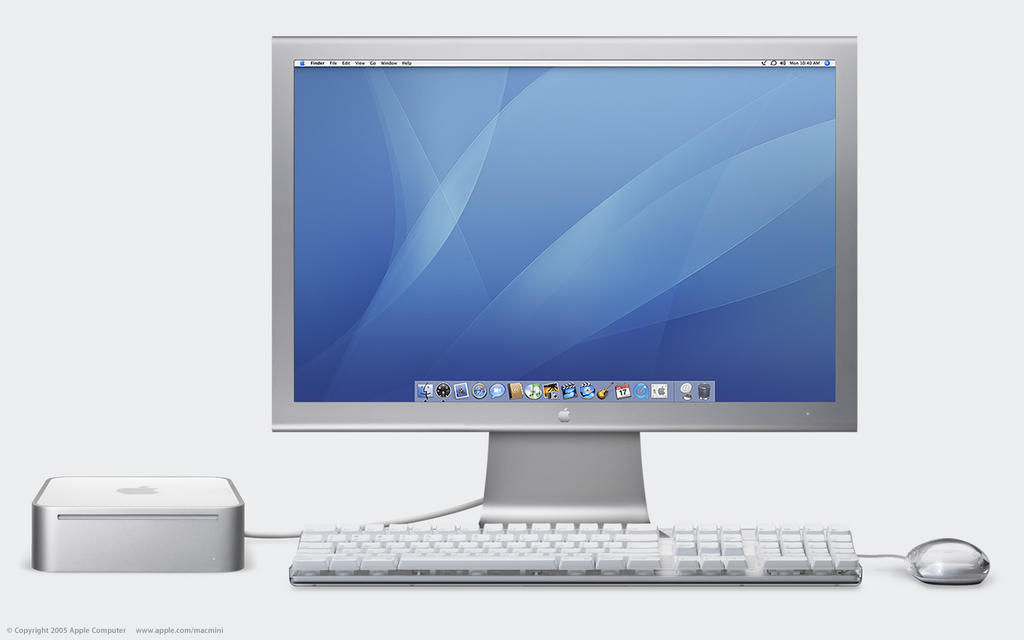
Apple has begun shipping upgraded Mac minis recently. Upgrades include a slightly faster CPU (up from 1.42 GHz to 1.5 in the top model), Bluetooth 2.0, an 8X SuperDrive, and a version of the Radeon 9200 updated with 64 MB memory (up from 32 MB). What's odd about this upgrade is that the Apple Mac mini page still lists the old Mac mini specifications. That may suggest that there is still a significant amount of inventory of the old model in the channel, and that Mac mini sales are perhaps not as good as Apple had hoped.
All of the upgrades are welcome, but the most significant upgrade is the video memory. 32 MB is not ideal for larger screen sizes, since things such as Exposé can slow down dramatically when there are several large windows open. 64 MB provides much more breathing room, especially when a large LCD screen such as Apple's 20" Cinema Display is used. However, it is a shame that the upgraded Mac minis still do not include a GPU that fully supports all of the features of Core Image. The Mac mini is Apple's last Mac that doesn't. Even the iBook now sports a fully Core Image compliant Radeon 9550.
Wednesday, September 14, 2005
IBM publishes 2.2 GHz G5 970FX power specs
IBM has published the IBM PowerPC 970FX Microprocessor Design Guide, in which it lists a 60 Watt maximum power specification for the 2.2 GHz 970FX.
This is in additon to the previously published 39 Watt specification for the 2.0 GHz 970FX.
One wonders what all of this means for the as yet unreleased 970MP, in terms of top speed and power utilization. Given that Apple already has 2.7 GHz G5 Power Macs for sale, one would hope that a dual-core version of the G5 would debut at 2.5 GHz, with acceptable power requirements.
This is in additon to the previously published 39 Watt specification for the 2.0 GHz 970FX.
One wonders what all of this means for the as yet unreleased 970MP, in terms of top speed and power utilization. Given that Apple already has 2.7 GHz G5 Power Macs for sale, one would hope that a dual-core version of the G5 would debut at 2.5 GHz, with acceptable power requirements.
Saturday, September 10, 2005
iPod nano: The beginning of the end of Firewire?
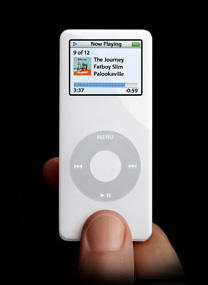
Apple's release of the iPod shuffle marked Apple's first iPod product without the support of Firewire. That was not totally unexpected however, considering the iPod shuffle is essentially a USB 2.0 pen drive that plays music as well. Implementing Firewire on such a product would have been quite problematic, given its overall design and form factor.
However, Apple has now released the iPod nano, the replacement to the very popular iPod mini, which also does not support Firewire synchronization. This is especially surprising considering it sports the normal iPod dock connector used in other units. One presumes that part of the reason for this is the iPod nano's very small size. The included chipset probably doesn't support Firewire, and adding full Firewire support would have meant a larger unit and higher cost.
Similarly, Apple's and Motorola's new ROKR iTunes phone doesn't support Firewire synchronization either.
It is somewhat unfortunate that Apple has gone this route. For fastest synchronization, USB 2.0 is required, but most of Apple's installed base of Macs do not support USB 2.0. (All currently shipping Macs do support USB 2.0 however.) Apple came late to the USB 2.0 party, but now has embraced it head-on at the expense of Firewire. Ironically, Firewire is a standard that Apple helped create.
The silver lining however is that synchronization of the iPod nano will still work on older Macs using USB 1.1 (albeit slowly), and the iPod nano is absolutely gorgeous. I want one... or three.
Thursday, August 18, 2005
Apple begins iMac G5 Repair Extension Program for Video and Power Issues
Apple today released a FAQ about their new iMac G5 Repair Extension Program for Video and Power Issues:
Somehow this all seems vaguely familiar.
[Update 2005-08-20]
The repair program includes the first G5 iMac models released in August 2004. It is not clear if the more recent G5 iMac models released in May 2005 are included. Newer 2.0 GHz iMacs do indeed fall into the serial number ranges, but Apple specifically leaves out 2.0 GHz model iMacs in the program description.
The iMac G5 Repair Extension Program for Video and Power Issues applies to first generation iMac G5 computers that have video or power-related issues as a result of a specific component failure. If your iMac G5 is exhibiting any of the symptoms listed below and your computer's serial number is within the noted ranges, your computer may be eligible for repair, free of charge. If Apple or an Authorized Apple Service Provider (AASP) determines that your iMac G5 computer is eligible as part of the program, the repair will be covered by Apple even if your iMac G5 is out of warranty. This is a worldwide Apple program.
Affected systems will exhibit one of the following video- or power-related symptoms :
Scrambled or distorted video
No video
No power
Note: If your iMac G5 is not experiencing any of these symptoms, you do not have to contact Apple or any Apple Authorized Service Provider.
Which iMac G5 computers are affected by the iMac G5 Repair Extension Program for Video and Power Issues?
The program is available for certain iMac G5 models that were sold between approximately September 2004 and June 2005 featuring 17- and 20-inch displays with 1.6GHz and 1.8GHz G5 processors.
The affected iMac G5 computers have serial numbers where the first 5 digits fall into the ranges noted below.
Serial Number ranges:
W8435 - W8522
QP435 - QP522
CK435 - CK522
YD435 - YD522
Somehow this all seems vaguely familiar.
[Update 2005-08-20]
The repair program includes the first G5 iMac models released in August 2004. It is not clear if the more recent G5 iMac models released in May 2005 are included. Newer 2.0 GHz iMacs do indeed fall into the serial number ranges, but Apple specifically leaves out 2.0 GHz model iMacs in the program description.
Wednesday, August 17, 2005
Apple's Security Update 2005-007 kills 64-bit support
Reports online state that apps that are compiled specifically for 64-bit G5 systems will no longer run after the latest Security Update 2005-007 in installed. Affected programs include many command line applications as well as the 64-bit version of Mathematica 5.2.
That something as obvious as this could be missed suggests that Apple really needs to revamp their software quality assurance program.
[Update 2005-08-18]
Apple has released Security Update 2005-007 Version 1.1 to correct the problem:
Security Update 2005-007 delivers a number of security enhancements and is recommended for all Macintosh users.
Security Update 2005-007 v1.1 replaces Security Update 2005-007 v1.0 for Tiger systems Mac OS X v10.4.2. Users who have already installed v1.0 on Tiger systems should install v1.1.
Security Update 2005-007 v1.1 provides a combined 32- and 64-bit version of LibSystem to replace the 32-bit version that was delivered in v1.0. No other changes have been made in version 1.1.
That something as obvious as this could be missed suggests that Apple really needs to revamp their software quality assurance program.
[Update 2005-08-18]
Apple has released Security Update 2005-007 Version 1.1 to correct the problem:
Security Update 2005-007 delivers a number of security enhancements and is recommended for all Macintosh users.
Security Update 2005-007 v1.1 replaces Security Update 2005-007 v1.0 for Tiger systems Mac OS X v10.4.2. Users who have already installed v1.0 on Tiger systems should install v1.1.
Security Update 2005-007 v1.1 provides a combined 32- and 64-bit version of LibSystem to replace the 32-bit version that was delivered in v1.0. No other changes have been made in version 1.1.
Subscribe to:
Posts (Atom)