Friday, December 09, 2005

Aperture runs on the G4 Cube

To my surprise, Aperture runs on my Cube, and runs tolerably. I had to hack it to get it to run, given that the Cube does not have official Aperture support, but everything works just fine (albeit fairly slowly). This Cube does have a 1.7 GHz G4 which is adequate as far as G4 speeds go, but the real surprise is that Aperture has no problem with this Cube's GeForce 2 MX, a GPU that is several generations behind even the GeForce FX 5200 (which is also unsupported). The GeForce 2 MX does not even fulfill the hardware requirements for Core Image's GPU-based acceleration. That likely means that Aperture supports Core Image's Altivec fallback on the CPU, despite the fact the application is built never to run on a machine like this. At least this GPU has Quartz Extreme support though. One wonders if Aperture could run on even an older GPU like the ATI Rage 128, which does not even support Quartz Extreme.

I won't detail the Aperture hack here, but suffice it to say that there are explanations available elsewhere out there online, and a valid serial number is still required of course. For the sake of all the people out there with adequately spec'd G4 Power Macs, I just hope that Apple doesn't choose to disable the hack in the 1.0.1 update to Aperture.

Now I said it's tolerable on the Cube, but in truth maybe I think it's tolerable just because I didn't test it for too long. Fortunately, I already have a faster and fully supported iMac (G5 2.0 & Radeon 9600 128 MB). Aperture is not particularly fast on my iMac either, but at least it's a noticeable improvement, although nowhere near as fast as the dual G5 2.3 GHz Power Mac with GeForce 6600 256 MB I had the chance to test out with this application.
Wednesday, December 07, 2005

No PowerBook G5 ever

In case you've been hiding under a rock and somehow still believe a PowerBook G5 is coming, this c|net article should finally convince you otherwise. Michael Mayer, CEO of Freescale, states that IBM chose not to finish the work on a laptop version of the G5, partially so that they could focus more of their resources on chips for game consoles. He should a pretty good idea of the goings-on at IBM too, as he was general manager of IBM Microelectronics until November 2003.

He also states that Jobs wanted to go with Intel chips many years ago, but it was the promise of the G5 that kept Apple on PowerPC. That is not a complete surprise, since Rhapsody was even released to developers on Intel, and we are all well aware of Apple's Marklar project. Furthermore Jobs has had a long and good relationship with Intel, partially because of his days at NeXT, and because of personal relationships with Intel brass. However, back then Apple was in a precarious position, and in my opinion it would have been a lot more risky then for Apple to go Intel than now. I'm sure Jobs didn't need a huge amount of convincing to stick with PowerPC, especially when it was IBM doing the convincing with the potential of their G5.

One other interesting point made in the article is that Apple has a contract with Freescale that doesn't end until 2008. I'm not sure what that means, but I would be somewhat surprised to see G4 Macs sold after 2006. That said, there will be a lot of G4 Mac repairs needed for years to come. It is possible that this contract is simply to ensure adequate repair parts are available until institutional G4 Mac AppleCare contracts expire.

Intel Macs: 666?

The DigiTimes reports that while new Intel Macs may be demoed at Macworld 2006 in January, they will not be released until June 6, 2006. That long of a lag time seems strange, but it's interesting that 06/06/06 date was mentioned (and not just for religious reasons). First of all, the date is exactly one year from the announcement of the switch to Intel. More important however is the fact that "666" has a special place in Apple's history, since the original Apple 1 was released at $666.66 (in 1976, making 2006 the 30th year Apple has been selling computers).

If that date is true, it could make sense for iBooks and Mac minis, since the cheaper single-core 1 MB L2 version of Yonah is scheduled for release in Q2 2006. However, I still hold out hope for a 13" PowerBook announcement in January. Such a machine could use a dual-core 1.66 GHz Yonah, or perhaps more likely, a single-core 1.66 GHz Yonah with 2 MB L2. Both chips are on target for release in volume in January.

One curious tidbit in the article is the claim that the new Macs will sport an "Intel Inside" logo. That seems particularly out of character for Apple, given Apple's extreme emphasis on aesthetics for its computers.

The article should be taken with a grain of salt though, since when it comes to Apple prognostication, The Digitimes has no better a record than the usual rumour sites, and it could just be that the sources quoted are simply repeating the June 6 date suggested last year.

Sunday, December 04, 2005

Hints to an Aperture hack

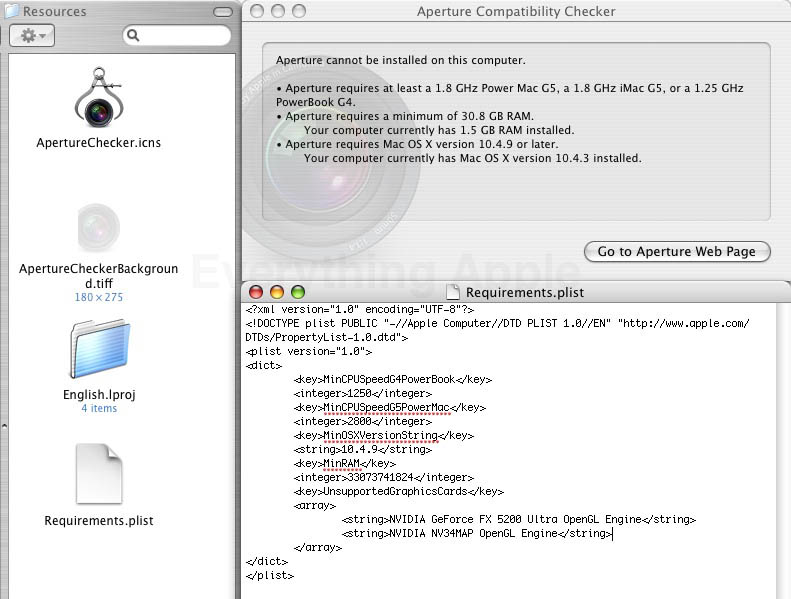
A lot of people (including myself) have been complaining that Aperture has unnecessarily strict hardware requirements. Well, it seems the Aperture Compatibility Checker may provide some hints as to how to ease some of these restrictions:


The above is the result I get with my modified Compatibility Checker on my fully supported iMac (20" G5 2.0 GHz, Radeon 9600 128 MB, OS X Tiger 10.4.3, 1.5 GB RAM).

[Update 2005-12-04]

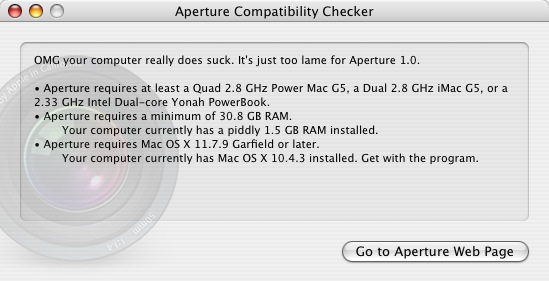
More fun with the Aperture Compatibility Checker. :)

Saturday, November 26, 2005

Aperture compatibility, and it's shipping?

According to the Apple Store front page, Aperture is now shipping. However, when you attempt to purchase it, it says it's shipping in one week. Furthermore, Amazon has a November 30 release date, and there have not yet been any reports of end users receiving their copies.

In addition, reports have been coming in about hardware compatibility with Aperture as determined by Apple's Aperture Compatibility Checker. Some confirm my observation that 2005 iBooks are listed as supported, but it seems the iBooks are the only big surprise. As expected from the minimum requirements, prelimary reports indicate that these Macs are NOT supported:

1) Any 12" PowerBook
2) Any G4 iMac
3) Any G4 Power Mac
4) G5 iMacs with GeForce FX 5200 Ultra (August 2004)
5) G5 Power Macs with GeForce FX 5200 Ultra (2003 & 2004)

I can understand Apple's decision not to support 12" PowerBooks or other Macs with GeForce 5200 series GPUs. Also, the G5 Power Macs are not a issue, since one can easily upgrade the GPU. However, given Apple's decision to support G4 PowerBooks, I do not understand their decision to exclude all G4 Power Macs, including duals. Perhaps Apple might have a change of heart later on and allow support of Power Macs with fast G4s and appropriate GPUs like the Radeon 9600 Pro or better, but I wouldn't count on it.

[Update 2005-11-26]

Aperture is now shipping. Emails went out today to some end users indicating their orders shipped today, with expected delivery beginning early next week.

[Update 2005-11-27]

I almost forgot... While I don't have end user confirmation of this yet, Aperture will not likely run on any 1.6 GHz Power Mac either, regardless of the video card. The 1.6 GHz G5 does not meet Apple's minimum CPU speed specification.

Intel iBook for January?

Several websites are reporting that Apple is preparing for a release of an Intel iBook in January. If it is only the iBook that is updated in January with an x86 chip, then this would be an interesting situation for Apple. According to Intel's mobile CPU roadmap January will see the release of a single-core and a dual-core Yonah CPU, both with 2 MB L2 cache. The iBook will undoubtedly get a single-core CPU, but I would have expected it to get the cheaper single-core Yonah with 1 MB L2. However that chip isn't scheduled for release until Q2 2006. One of several things could be true: 1) There is no January iBook, or 2) The iBook will get a souped up 2 MB L2 single-core Yonah, or 3) The roadmap is wrong. A souped up Yonah single-core would not be extremely cheap. One would hope that Intel in the iBook doesn't mean increased prices over what current iBooks cost. Perhaps there is a fourth option: Maybe the Intel machine for January isn't an iBook at all. Besides the possible Intel Mac mini, it could be that Apple will introduce a replacement to the 12" PowerBook. This would make sense, since at the last PowerBook update the 12" saw no significant upgrades.

The other interesting part about this iBook prediction is the fact that there is no mention of any upgrade to the PowerBook line. If the iBook (or smallest PowerBook) did get the single-core Yonah with 2 MB L2 in January, it'd be at 1.66 GHz. Such a chip would be faster than the G4 in any current PowerBook in existence (at least with software that runs natively on x86). For this reason one would expect that after such an update, it wouldn't be too long before the (larger) PowerBooks got upgraded too. However, I will admit that one problem with this reasoning is the spectre of software compatibility. PowerBook users often need pro Mac software, and an early PowerBook Intel migration would mean that some pro software may not work on these machines. However, if the Altivec'd Rosetta rumours are true, then this pro software issue could be somewhat less significant.