Wednesday, June 29, 2005

Apple's hints for the iTunes phone?

It seems Apple may also be giving us hints as to what the iTunes phone will look like. If you change your screen to 256 colours in the Displays preferences, and then look at the preferences for iTunes 4.9, the purple Podcast icon will have changed to what appears to be a white phone.

In addition, macprime has discovered an icon for a white phone in iTunes 4.9.

Tuesday, June 28, 2005

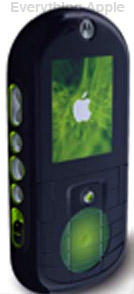
Motorola leaks picture of iTunes phone?

Motorola leaks picture of iTunes phone?
Michael Tatelman, Vice President and General Manager of Mobile Devices for Motorola North Asia, gave a presentation to Morgan Stanley analysts recently, which shows this picture of a phone with an Apple logo.

Given its aesthetics, one can only hope it's just a mock-up, and not the real iTunes phone.

[Update 2005-06-28]

AppleInsider, Engadget, and c|net all now seem to have picked up on this. For the record, I'd be surprised if the phone really did look like this. I'm more inclined to believe the Le Figaro article, which states the phone is a white one close to Motorola's E398.

[Update 2005-06-29]

MacDailyNews has posted more pictures that add support to the rumours that the iTunes phone is in fact similar to the one shown here.

[Update 2005-07-03]

I am happy to report that the iTunes phone is not black and green. As originally thought, the E790 is white and based off the E398.

Saturday, June 25, 2005

Pro Tools LE now supported in Tiger 10.4

Digidesign this week announced Tiger support with Pro Tools LE 6.9.2.

Steve Jobs wasn't lying when he said that Tiger support would come to Pro Tools quickly.

Friday, June 24, 2005

New Apple product July 7: iTunes phone?

MacBidouille.com reports that Apple has asked members of the press to be prepared for a new announcement from Apple in two weeks, on July 7.

We don't know what is going to be announced, but I suspect that it could be the Motorola/Apple iTunes phone, although it could be something like the new version of iTunes with Podcasting support. If they do announce the iTunes phone, I'd consider buying it if it had these features:

Aesthetically pleasing
Lightweight (115 g or lighter, preferably with a candy bar form factor)
GSM with quad band support (850/900/1800/1900)
Bluetooth 2.0 enabled (for quick Address Book and iCal synching)
Wired USB 2.0 support (for music synching)
Headphone jack
Reasonably good quality 2 Megapixel camera (preferably with autofocus)
Enough memory for music & pictures (or removable flash media support)
US$500

However, I suspect the iTunes phone (whenever it is finally released) could be a lower end phone with less features, for marketing reasons.

[Update 2005-06-25]

French language newspaper Le Figaro is reporting that Motorola and Apple will release the iTunes phone very soon. They also report that it will have the form factor of the E398, and will be ivory white in colour.

The E398 is a mid-end phone, but even if the phone looks like the E398, there is no guarantee that the phone will have the same specifications as the E398. Mobile Gazette reported rumours in May that the phone would be designated as E790. The E790 would be based off the E398, but would include some higher end features in addition to its iTunes support. I will note that the A780 has quad band support and a better camera. The A780's form factor is different from the E398, but it is possible that the similar model number of the rumoured E790 may reflect a similar feature set to the A780. However, rumoured specifications posted at Mobile Review would suggest otherwise.

Tuesday, June 14, 2005

Apple's SEC filings and the Intel transition timeframe

If one searches through Apple's SEC filings, one can find details of the sales agreement between Apple and IBM. Agreement No. 000451 includes this statement:
This Custom Sales Agreement between Apple Computer, Inc. (“Apple”) and International Business Machines Corporation (“IBM”), which consists of this Base Agreement and Statement of Work Attachments, shall be referred to as the “Agreement”. The term of this Agreement commences on October 21, 2002 and expires on October 20, 2007.
This would explain much of Apple's reasoning for the two-year transition period to Intel, since both the Apple-IBM agreement and Apple's Intel transition period are slated to end in 2007. This works out well, since it gives Apple's engineers and third party developers enough time to get everything working properly and fast on Intel's chips. Furthermore, Intel hopes to have dual-core desktop/server chips with 64-bit support out by 2007 too, so the timing is perfect for a 2007 64-bit x86 Power Mac and Xserve update. Also, OS X 10.5 Leopard would already have been released by then, and should be fully 64-bit (unlike 10.4 Tiger). Interim Power Macs and Xserves would use new IBM chips (likely including the dual-core G5 970MP), while Apple's lower-end Macs would move Intel more quickly, using its low power 32-bit offerings (in 2006).

Some might wonder if Jobs had been chomping at the bit all along for such an x86 switch, with the partnership with IBM just being something to get Apple through the OS 9 -> OS X transition. However, I suspect if IBM had had more success with releasing faster G5 chips for the desktops and low power G5s for the laptops (and IBM had a promising future roadmap in terms of both chip technology and price) then Apple would have stuck by them.

Thanks to stingerman in the Ars forums for pointing me in the direction of the SEC filings.

Sunday, June 12, 2005

Ars posts hypothetical x86 Mac roadmap

Jon Stokes at Ars has posted his thoughts on the Apple-to-Intel transition and postulates a roadmap for Apple's adoption of x86 chips.

Much of it does make sense, but I'd be surprised if the Mac mini and iBook got the dual-core Yonah. The Mac mini and iBook are low cost machines, and I would expect them to get single-core variants of Yonah to keep costs down. The single-core Yonah parts would be more than sufficient, since even at 1.66 GHz, they are faster than the fastest G4 in current PowerBooks.

I would agree the PowerBooks will get dual-core Yonah chips. However, I am not entirely sure what will happen to the iMac. Like Ars, I would expect it to get a dual-core chip of some sort, but I don't think we can exclude just yet the possibility that it could get a single-core chip, since it is a consumer-oriented machine after all.