Apparently Apple has been experimenting with 3G MacBook Pro designs in the recent past. AlricLantra from the AnandTech Forums has recently gotten his hands on a MacBook Pro prototype with a 3G SIM card slot (although the slot is non-functional). Ultimately the decision was made not to include 3G at that time, but the engineer was allowed to keep the unit for personal use.
I personally would have little use for 3G support, since I have an iPhone 4 and can tether my MacBook Pro to it. I'm on Fido in Canada with a 1 GB data plan, and tethering support is included in this plan. However, 3G (or 4G) data support would be an interesting option for some MacBook Pro or MacBook Air users, similar to the 3G option for the iPad.
Monday, May 16, 2011
Thursday, October 21, 2010
Apple Java is dead
Apple has deprecated its version of Java.
What this means is that Apple's Java will not be bundled with OS X 10.7 Lion. Interesting. I'm not sure why they did this, but perhaps it was too much of a headache, or maybe (like with Flash) they just wanted that third part technology out of Macs. I wonder if Sun/Oracle will pick up the slack to have a good version out by summer 2011, when Lion is released.
Could Blu-ray implementation in Lion have anything to do with this? Maybe not, but one can hope...
What this means is that Apple's Java will not be bundled with OS X 10.7 Lion. Interesting. I'm not sure why they did this, but perhaps it was too much of a headache, or maybe (like with Flash) they just wanted that third part technology out of Macs. I wonder if Sun/Oracle will pick up the slack to have a good version out by summer 2011, when Lion is released.
Could Blu-ray implementation in Lion have anything to do with this? Maybe not, but one can hope...
Monday, October 18, 2010
Apple has first $20 billion quarter.
Apple has achieved a remarkable milestone, with its first ever $20 billion quarter. Along with that was a record profit of $4.31 billion, beating IBM's $3.59 billion. Little brother IBM?
In true market form though, AAPL dropped over 6% to below $300 in after hours trading, on lower guidance and news that the iPad has sold lower numbers than expected by the street.
In true market form though, AAPL dropped over 6% to below $300 in after hours trading, on lower guidance and news that the iPad has sold lower numbers than expected by the street.
Saturday, October 16, 2010
Will there be an 11" MacBook Air?
There are lots of rumours swirling that Apple will release an 11.6" MacBook Air on October 20. Personally, I'd like to see this happen (and I've been wanting one for a long time), since in my view the expensive 13" Air never made a whole lot of sense. It has the same footprint as the 13" MacBook Pro, has no optical drive, is slower, has fewer ports, yet costs a lot more. In other words, Apple provided a severely dumbed down 13" MacBook Pro for a heluvalot more money.
My favourite Mac laptop form factor of all time is the 12" iBook/PowerBook. Sure it was a bit bulky and it wasn't super light, but it had a much smaller footprint than my current 13" MacBook Pro. Remove the optical drive, swap in a widescreen 11.x" 1366x768 monitor, make it thinner, and you've got a winner… but only if the price is right.
With the PowerBook line, smaller and less feature rich meant cheaper. With the Air, Apple reversed direction and declared thinner (but with the same footprint) and less feature rich means more expensive. In fact, lots more expensive.
One theory is that any new 11.6" MacBook Air would only have an SSD, with no option for a conventional hard drive. If this decision is made, then the machine could be one of the smallest ever made… but could also be horrendously expensive for that category.
What I want is an inexpensive machine that's lighter and easier to use on the plane than a 13" laptop. SSD is nice, but for most people (including myself) not really worth the price premium at this time. If Apple gives us another overpriced Air, just in a smaller form factor, I may just end up getting a Windows 7 11.6" machine instead. However, that's assuming that AMD can come through with its low power but reasonably performing and inexpensive Ontario APU, or else Intel can price one of their low power but high performing chips competitively.
By the way, I have been playing with an older Windows 7 dual-core Atom machine, with NVIDIA ION GPU. I'm pleasantly surprised. It's reasonably responsive, and even plays Blu-ray smoothly. I'm enjoying the machine more than I thought I would, and that's why I'm considering a 11"-12" Windows 7 laptop for 2011… unless Apple can provide us with a smaller but decently priced MacBook Air.
My favourite Mac laptop form factor of all time is the 12" iBook/PowerBook. Sure it was a bit bulky and it wasn't super light, but it had a much smaller footprint than my current 13" MacBook Pro. Remove the optical drive, swap in a widescreen 11.x" 1366x768 monitor, make it thinner, and you've got a winner… but only if the price is right.
With the PowerBook line, smaller and less feature rich meant cheaper. With the Air, Apple reversed direction and declared thinner (but with the same footprint) and less feature rich means more expensive. In fact, lots more expensive.
One theory is that any new 11.6" MacBook Air would only have an SSD, with no option for a conventional hard drive. If this decision is made, then the machine could be one of the smallest ever made… but could also be horrendously expensive for that category.
What I want is an inexpensive machine that's lighter and easier to use on the plane than a 13" laptop. SSD is nice, but for most people (including myself) not really worth the price premium at this time. If Apple gives us another overpriced Air, just in a smaller form factor, I may just end up getting a Windows 7 11.6" machine instead. However, that's assuming that AMD can come through with its low power but reasonably performing and inexpensive Ontario APU, or else Intel can price one of their low power but high performing chips competitively.
By the way, I have been playing with an older Windows 7 dual-core Atom machine, with NVIDIA ION GPU. I'm pleasantly surprised. It's reasonably responsive, and even plays Blu-ray smoothly. I'm enjoying the machine more than I thought I would, and that's why I'm considering a 11"-12" Windows 7 laptop for 2011… unless Apple can provide us with a smaller but decently priced MacBook Air.
Saturday, June 26, 2010
iOS 4 is very, very slow on the iPhone 3G
After a brief test period with iOS 4 on my iPhone 3G, I have reverted back to iPhone OS 3.1.3. Using iOS 4 on the 3G was utterly painful. Everything was laggy, and certain basic functionality like listening to music or even just answering the phone was problematic with iOS 4.
When I would listen to music and surf the net over 3G data at the same time, the music would sometimes skip. Completely unacceptable. Other applications would often have a few second lag too before I could interact with them. This even was true for answering the phone. If I was for example reading email and a call came in, the phone would go to the call screen, but wouldn't allow me to answer it right away. The swipe-to-answer finger gesture wouldn't work as the screen would be unresponsive for a few seconds. If the caller didn't stay on the line long enough I'd miss the call. Very irritating. This was never a problem on the 3G with previous versions of iPhone OS.
So, I downgraded back to OS 3, following these good instructions.
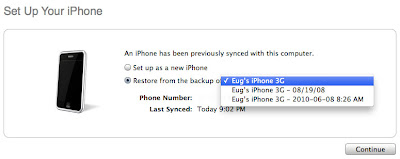
While reports of lag with the 3G are common, people have not been reporting it with the iPhone 3GS. While the iPhone 3GS has a faster CPU, I suspect it has more to do with memory. The 3G has 128 MB RAM, while the 3GS has twice that, at 256 MB. That's a huge difference, presumably saving on page-outs to flash memory. (The iPhone 4 has 512 MB RAM, which is actually twice as much as the iPad.)
I don't know if Apple will be able to address this performance issue on the 3G with future iOS 4 point updates. Hopefully they will, but no guarantees. At this point the iOS 4 features are not a big loss though, since multitasking of third party apps isn't offered on the 3G anyway, and folders as currently implemented in iOS 4 aren't something I will miss much. However, in the future, iOS 4 will be more of a necessity, as applications will eventually start requiring iOS 4 or higher to function.
When I would listen to music and surf the net over 3G data at the same time, the music would sometimes skip. Completely unacceptable. Other applications would often have a few second lag too before I could interact with them. This even was true for answering the phone. If I was for example reading email and a call came in, the phone would go to the call screen, but wouldn't allow me to answer it right away. The swipe-to-answer finger gesture wouldn't work as the screen would be unresponsive for a few seconds. If the caller didn't stay on the line long enough I'd miss the call. Very irritating. This was never a problem on the 3G with previous versions of iPhone OS.
So, I downgraded back to OS 3, following these good instructions.

While reports of lag with the 3G are common, people have not been reporting it with the iPhone 3GS. While the iPhone 3GS has a faster CPU, I suspect it has more to do with memory. The 3G has 128 MB RAM, while the 3GS has twice that, at 256 MB. That's a huge difference, presumably saving on page-outs to flash memory. (The iPhone 4 has 512 MB RAM, which is actually twice as much as the iPad.)
I don't know if Apple will be able to address this performance issue on the 3G with future iOS 4 point updates. Hopefully they will, but no guarantees. At this point the iOS 4 features are not a big loss though, since multitasking of third party apps isn't offered on the 3G anyway, and folders as currently implemented in iOS 4 aren't something I will miss much. However, in the future, iOS 4 will be more of a necessity, as applications will eventually start requiring iOS 4 or higher to function.
Wednesday, June 16, 2010
iPhone 4 in Canada factory unlocked from Apple
My globetrotting friends are pleasantly surprised to see that in Canada, we will be able to get the iPhone 4 unlocked straight from Apple.
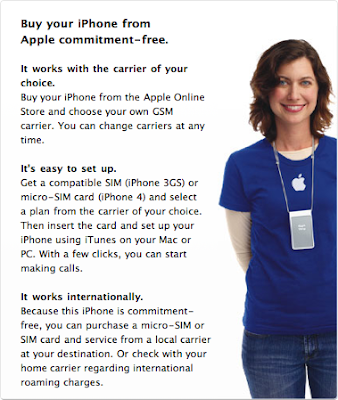
An iPhone 4 not subsidized by a carrier contract will be costly, but it still actually is cheaper for those who spend a lot of time out of the country. They will be getting the iPhone 4 sans contract, and will use local service in the countries they visit, either through a regular wireless account or through prepaid SIM cards. Well, if they can find local micro-SIM cards that is.
I personally will probably still sign a contract to get a subsidized iPhone 4. However, given Fido's annoying stacked contacts, I'm also considering going to a new carrier for my iPhone 4 after my current 3G's 3-year contract runs out, but only if they can offer decent voice and data plans. Fortunately, the big three in Canada - Rogers, Telus, and Bell - all offer the iPhone now.
An iPhone 4 not subsidized by a carrier contract will be costly, but it still actually is cheaper for those who spend a lot of time out of the country. They will be getting the iPhone 4 sans contract, and will use local service in the countries they visit, either through a regular wireless account or through prepaid SIM cards. Well, if they can find local micro-SIM cards that is.
I personally will probably still sign a contract to get a subsidized iPhone 4. However, given Fido's annoying stacked contacts, I'm also considering going to a new carrier for my iPhone 4 after my current 3G's 3-year contract runs out, but only if they can offer decent voice and data plans. Fortunately, the big three in Canada - Rogers, Telus, and Bell - all offer the iPhone now.
Subscribe to:
Posts (Atom)