Apple today dropped a bombshell on the Mac community by announcing a new Apple-supported bootloader called Boot Camp. For those who have Intel Macs, this software will allow boot support for Windows XP. Although Apple Intel Macs use EFI, the latest firmware update adds support for OSes that require BIOS compatibility. In traditional Mac fashion, Boot Camp makes it easy for users to partition their hard drives and install Windows XP, and provides a menu to choose between the different OSes at bootup.
For those wishing to try out this software, just remember Boot Camp is still in beta. A few users have reported serious problems with the install. Also, for those who wish to write to the Windows partition from within Mac OS X, FAT32 should be used as the file format, since OS X has full FAT32 read/write support. NTFS is not recommend because OS X can only read NTFS and not write to it.
The investors loved the news, and drove AAPL up 9.87% to US$67.21.
Wednesday, April 05, 2006
Tuesday, April 04, 2006
10.4.6 adds functionality, speeds up Aperture
Apple's OS X 10.4.6 update was released yesterday, and some of the upgrades include new support for Nikon D200 .NEF and Canon 30D .CR2 RAW files, as well as a fix for the EXIF bug for exported TIFF files from Aperture.
In addition, with 10.4.6, Aperture 1.0.1 is now much more responsive. For example, just viewing heavily adjusted 8 MP images on my iMac G5 2.0 through Aperture's loupe was quite a laggy process. Although some of the lag is still there in 10.4.6, it is greatly reduced compared to 10.4.5.
This is a nice improvement for Aperture that will tide us over until the full Aperture 1.1 update arrives this month.
In addition, with 10.4.6, Aperture 1.0.1 is now much more responsive. For example, just viewing heavily adjusted 8 MP images on my iMac G5 2.0 through Aperture's loupe was quite a laggy process. Although some of the lag is still there in 10.4.6, it is greatly reduced compared to 10.4.5.
This is a nice improvement for Aperture that will tide us over until the full Aperture 1.1 update arrives this month.
Friday, March 31, 2006
Aperture 1.1 delayed, but Aperture Product Manager Schorr says release is very soon
Aperture 1.1 was supposed to be released in March, but the date has slipped until April. To ease everyone's concerns, Joe Schorr, Product Manager for Aperture, reiterates that the release is very soon:
I know many of you are very anxious to start using 1.1 and I sincerely apologize for the delay in getting it to you. I can assure you that we are VERY close to finalizing this release, but we simply felt it was very much in the best interests of our customers to slightly extend the testing period.
Friday, March 17, 2006
Bootloader to run Windows XP on Intel Macs available
Many of you may have heard that the problem getting Windows XP running on an Intel Mac has been solved. Now you can join in the fun too. The solution is now available for download. However, this is only a 0.1 release. Install at your own risk.
Sunday, March 05, 2006
G4 7448 puts out 30 Watts
The G4 7448 is not vapourware. However, it's too little too late for Macs obviously. Nonetheless, I thought it would be interesting to peruse the specifications of this chip for ol' times sake.
It turns out the chip isn't a particularly cool chip, even though it is manufactured on a 90 nm process. At 1.7 GHz, it puts out 30 Watts:
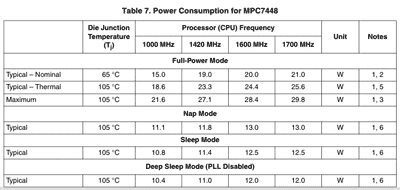
In other words, it puts out almost as much heat as both cores combined of a higher clocked Intel Core Duo chip, and each core alone would on average be faster than the G4 1.7 in native applications, even despite the new G4's bump in L2 cache.
It turns out the chip isn't a particularly cool chip, even though it is manufactured on a 90 nm process. At 1.7 GHz, it puts out 30 Watts:
In other words, it puts out almost as much heat as both cores combined of a higher clocked Intel Core Duo chip, and each core alone would on average be faster than the G4 1.7 in native applications, even despite the new G4's bump in L2 cache.
Thursday, March 02, 2006
Intel GMA 950: Terrible OpenGL performance
The first benches of the Intel Mac mini are out, and among them are some Cinebench scores. As suspected, the OpenGL performance of the integrated Intel GMA 950 graphics chipset leaves much to be desired:
The good news is that the other benches confirm the great superiority of the Core Solo CPU over the G4. Clock-for-clock, Core Solo is 40% faster. Furthermore, we must not forget about the 1.66 GHz Core Duo Mac mini, which scores 471 in the CPU rendering test, over 3X as fast as the old 1.5 GHz G4 Mac mini.
Mac mini G4 1.5 GHzIn the OpenGL Hardware Lighting test, the old G4 Mac mini with Radeon 9200 is actually 20% faster than the new Intel Mac mini. In fact, even the CPU-dependent OpenGL Software Lighting test on the Intel Mac mini is faster. While it's true that the Cinebench OpenGL test may not be representative of gaming performance, this does illustrate just how much of a limitation the new Intel Mac mini's integrated graphics can be.
Rendering (Single CPU): 152
Shading (CINEMA 4D): 159
Shading (OpenGL Software Lighting): 414
Shading (OpenGL Hardware Lighting): 506
OpenGL Speedup: 3.18
Mac mini Core Solo 1.5 GHz
Rendering (Single CPU): 213
Shading (CINEMA 4D): 259
Shading (OpenGL Software Lighting): 885
Shading (OpenGL Hardware Lighting): 441
OpenGL Speedup: 3.41
The good news is that the other benches confirm the great superiority of the Core Solo CPU over the G4. Clock-for-clock, Core Solo is 40% faster. Furthermore, we must not forget about the 1.66 GHz Core Duo Mac mini, which scores 471 in the CPU rendering test, over 3X as fast as the old 1.5 GHz G4 Mac mini.
Subscribe to:
Posts (Atom)