Tuesday, November 14, 2006

My Macs and the Xbox 360 HD DVD drive

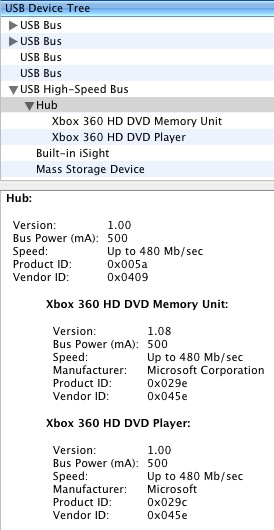
Yesterday, shortly after I wrote the Xbox 360 HD DVD drive article, my local store got the Xbox 360 HD DVD drives in, so I was able to try it myself on my Macs. As expected, the drive is recognized immediately.


There is a separate Xbox 360 HD DVD Memory Unit listed because HD DVD players must include non-volatile memory for things such as user bookmarks, etc. On my Macs CDs and DVDs play fine using this drive, but commercial HD DVDs are not natively supported by OS X Tiger (yet).


With Windows Vista on my MacBook, commercial HD DVDs are recognized (but are not playable without the correct software). The drive is recognized as a Toshiba DVD/HD X807616 USB Device. Out of interest's sake, I checked out the disc sizes of some HD DVDs. King Kong (a 188 minute movie) is 27.4 GB, but Corpse Bride is only 19 GB. The Polar Express, a reference quality 100 minute disc, is reported to be only 13 GB.

Monday, November 13, 2006

Xbox 360 HD DVD drive works in Mac OS X

Microsoft has recently released the HD DVD add-on drive for the Xbox 360, to rave reviews. HD DVD playback is apparently absolutely stunning with this setup, as it can output HD DVD's native 1080p24 content at full resolution using VGA, and up to 1080i over component connections. (I say apparently, because we Canadians still don't have this drive, although we'll probably get it this week.)

We've known for quite some time that although Microsoft is not supporting this drive on Windows, they didn't do anything to the drive to prevent its usage on a PC (according to Amir, a Microsoft executive who posts at the AVS Forum). Thus, it was no surprise when people proved that the HD DVD drive works on a PC. Also, unsurprisingly, it works on Mac OS X too.

With the proper hardware and software, commercial HD DVDs play back fine on Windows. Unfortunately, the same is not true on Mac OS X. While DVD Player.app does support HD DVD, I believe that it does not support VC-1 encoded material (which is what most commercial HD DVDs are), and does not support the copy protection and encryption used on commercial discs either. I am guessing that such support may come in 2007 however.

In other news, Connect360 can now stream WMV video, including full HD 1080p24 WMV, from a Mac to the Xbox 360.

Sunday, October 29, 2006

GeForce 6200 Cube benchmarks

The hackers out there have gotten various PC video cards to work in the Cube, and one of their latest successes is the GeForce 6200 (even though a Mac version of this card has never existed). I was lucky enough to get a hold of one of these and test it against various other video cards that work in the Cube.

Test setup:

Power Mac Cube with Sonnet 1.7 GHz G4 7447A
Mac OS X 10.4.8 Tiger
1.5 GB SDRAM (100 MHz bus)

Apple OEM Rage 128 Pro 16 MB
Apple OEM GeForce2 MX 32 MB
Flashed PC Radeon 9200 128 MB DDR
Flashed PC GeForce 6200 256 MB GDDR2

All of the above cards are fanless. The Rage 128 is the coolest running, while the GeForce2 MX seems to be the hottest. The Radeon 9200 and GeForce 6200 both get very warm under heavy usage, but their heatsinks do not get as hot to the touch as the GeForce2 MX. (The GeForce2 MX tested here is the one found in older G4 Power Mac towers, as opposed to the original Cube GeForce2 MX which had a large Cube-specific heatsink.)

The first test is OpenMark 1.60, a basic OpenGL benchmarking utility.
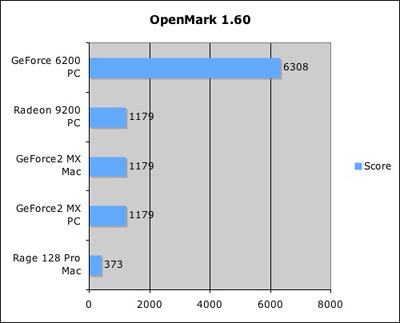

As you can see, the results generated by this application are not particularly fine-grained, as three of the video cards get the exact same result. It does show the marked performance advantage of the GeForce 6200 though.

OpenMark also tells us what level of OpenGL is supported by these GPUs:

ATI Rage Pro 128 - OpenGL 1.1
GeForce2 MX - OpenGL 1.1
Radeon 9200 - OpenGL 1.3
GeForce 6200 - OpenGL 1.5

In contrast, my iMac Core 2 Duo's GeForce 7600GT supports full OpenGL 2.0.

The second test is the popular Cinebench 9.5 OpenGL benchmark.
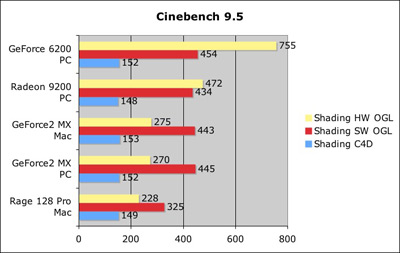

Hardware shading on the GeForce2 MX is actually slower than software. It takes the Radeon 9200 to (barely) show some hardware advantage over software. In contrast, the GeForce 6200 shows a big performance boost with hardware 3D acceleration.

It's interesting to see that the ATI Rage 128 Pro is significantly slower in the software bench than the other GPUs. This could be related to its lack of Quartz Extreme support, as this GPU is the only one of the four incapable of this OS X feature. I also note that in daily usage even things like basic 480p H.264 QuickTime playback is problematic on the ATI Rage Pro.

Would I recommend the GeForce 6200? Not necessarily to the average user. The 6200 is not an officially supported card, so it's possible one could run into problems. For instance, while it works perfectly over VGA, I have noticed that over DVI, things like Exposé and the Genie Effect aren't quite as smooth. However, otherwise the 6200 is a fine performance upgrade, and gives the 6 year-old Cube full Core Image and Core Animation capabilities.
Thursday, October 26, 2006

Adobe Soundbooth: No PowerPC support, ever.

Adobe has announced a new sound editing application called Soundbooth, and has posted a free beta preview of the application. That's the good news. Now the bad news:
Will there be a PowerPC version?

No. Apple is quickly moving its focus towards Intel Macs, and no longer sells Power PC systems in many places. By focusing on Apple's future, we have been able to bring this powerful application to the Mac platform much more rapidly, and with a stronger feature set.
Visit the Adobe Intel Mac FAQ for more information.
That is extremely disappointing, especially considering that the vast majority of current Mac users have PowerPC Macs, and many stores (including Apple's own refurbished Mac store) still sell PowerPC Macs.

[Update 2006-10-30]

Adobe's John Nack responds:
Here's the reality: Apple's migration to Intel chips means that it's easier to develop for both Mac and Windows, because instead of splitting development resources optimizing for two different chip architectures, you can focus on just one. That's all good, and it makes Mac development more attractive. Users benefit from having developers' efforts go elsewhere (features, performance tuning, etc.), rather that into parallel, duplicate work. In the case of Soundbooth, the team could leverage Adobe's expertise in building great audio tools for Intel chips (namely Audition) to bring the app to market faster and with a richer feature set.

Thursday, October 19, 2006

Apple screws up, blames Microsoft

Apple yesterday admitted that they shipped a number of iPods to customers with a Windows worm on them, which infected several customers' PCs.

Instead of simply issuing a standard press release, Apple instead decided to throw in a dig at Microsoft:
As you might imagine, we are upset at Windows for not being more hardy against such viruses, and even more upset with ourselves for not catching it.
Jon Poon, who works for Microsoft scanning its software before it's released, was quick to respond:
Instead of focusing on how and why it was even included in the first place, the company that published a series of video ads, including this one, actual try to divert the blame on the Windows platform!

It's not a matter of which platform that the virus originated. The fact that it's found on the portable player means that there's an issue with how the quality checks, specifically the content check was done. This also indicates that through the manufacturing cycle, the base device from which the image was duplicated to the other devices in the manufacturing run, was connected to a PC that most probably did not have , and i quote their press release, "up to date anti-virus software which is included with most Windows computers".
Mr. Poon is absolutely correct. Apple's attempt to try to shift partial blame onto Microsoft, even if in jest, simply comes across as being unprofessional.

Wednesday, October 18, 2006

Apple holds 6.1% US computer market share

In Q4 2006, Apple had its best best quarterly Mac sales ever, with 1.61 million Macs sold. This propelled Apple to the #4 position in the US, with 6.1% US PC market share.

Apple closed at $74.53 today, but after the earnings announcement it jumped to over $78 in after-hours trading.